AI-native software development

Build software with a swarm of AI agents.

Every agent runs in its own sandbox, in the cloud — nothing on your machine. Manage dozens, effortlessly.

app.darting.dev
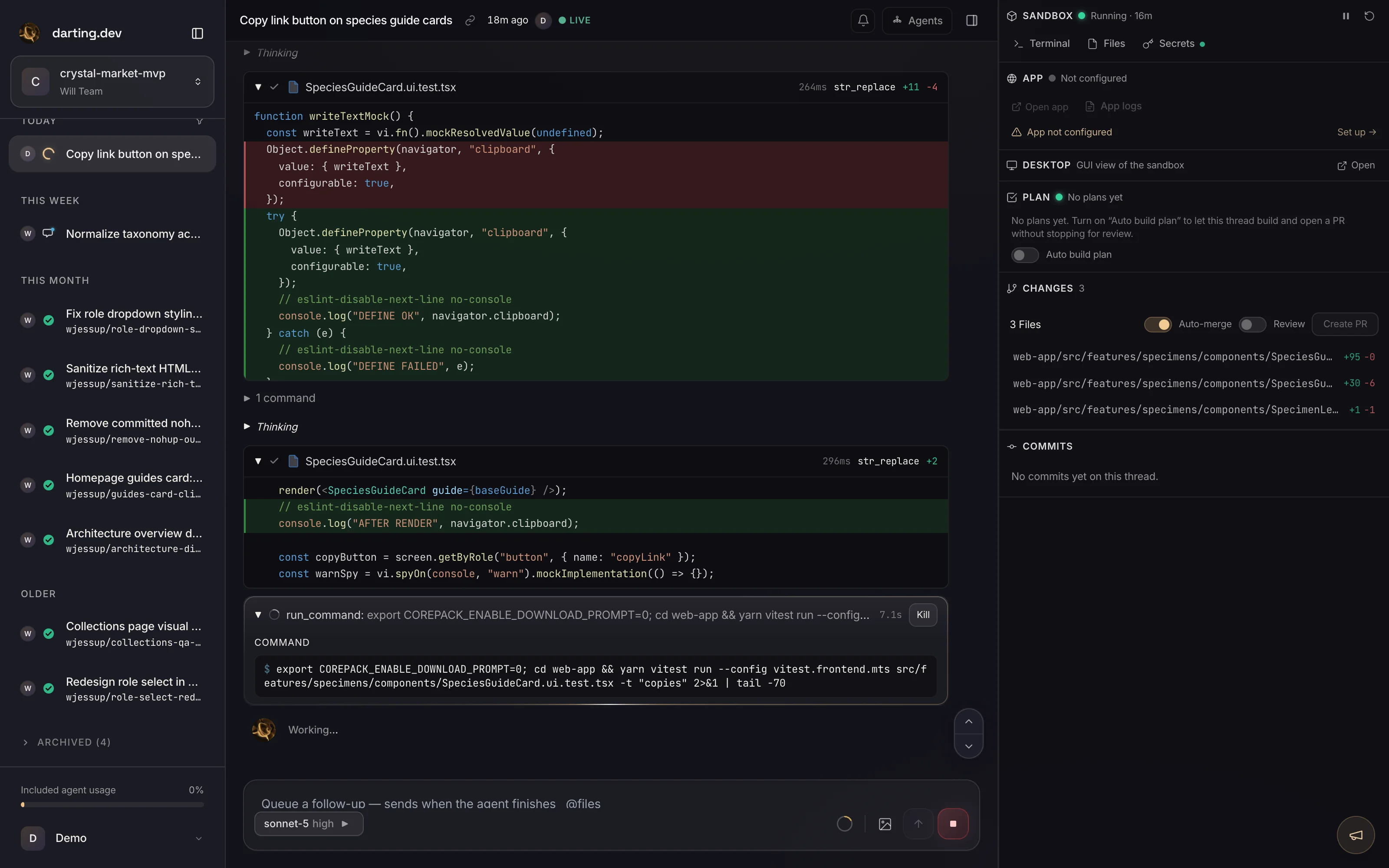
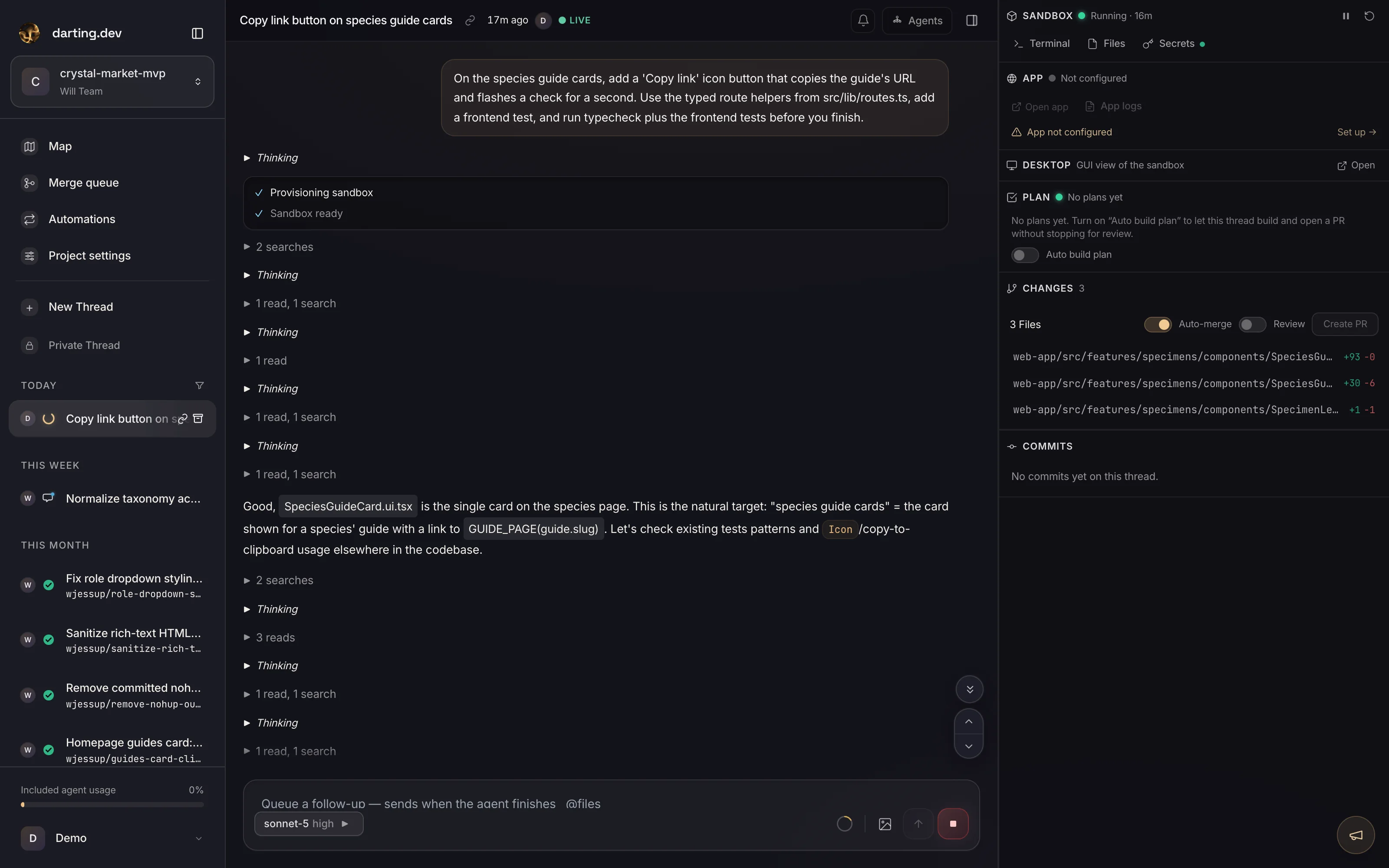
A darting.dev thread mid-run: streaming agent work, plan card, and a sandbox with changes ready to become a pull request
The merge queue

Merging isn't your job anymore.

A smart queue groups open PRs by the files they touch. Unrelated groups land in parallel; within a group the oldest merges first and the rest follow. Arm auto-merge when you're ready — green checks land without rebase mornings or conflict archaeology.

  • Auto-merge on green — only after you arm it
  • File-overlap grouping prevents conflicts before they exist
  • Main stays releasable while twenty branches land
app.darting.dev
The darting.dev merge queue: a real pull request waiting on checks, grouped to merge independently, with auto-merge on green armed when you opt in
Living plans

Your plans never go stale.

Work moves so fast here that a plan is out of date before you finish reading it. So plans are versioned documents the system keeps honest — re-checked against main as code lands, updated when the ground shifts, one click from building.

  • Every plan is a versioned document with history
  • Staleness checks re-verify plans as main moves
  • Build it → a thread picks the plan up and opens a PR
app.darting.dev
The darting.dev plans collection: versioned plan documents with pending and building statuses, each one click from being built
The detail view

Zoom in. It already proved itself.

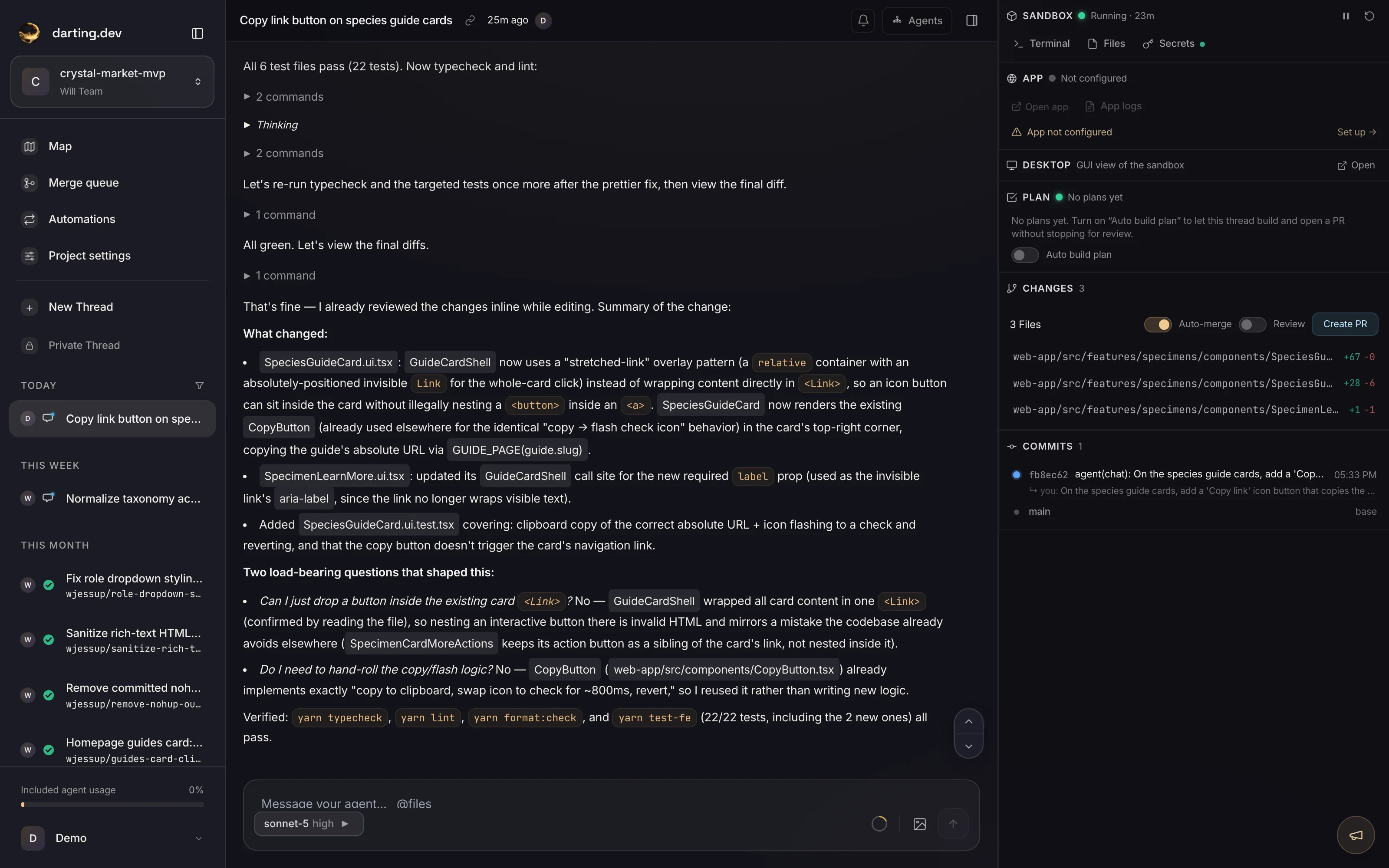
Open any thread when you care: the full run with real diffs, test output, and video proof, ending in a verified commit ready for a PR. Zoom out when you don't — arm auto-merge and green CI finishes the job.

  • Typecheck, lint, and tests run before the commit lands
  • Video proof of the working feature, recorded in the sandbox
  • Every thread ends in a pull request
app.darting.dev
A completed darting.dev run: the agent summarizes what changed, verification passes (typecheck, lint, 22 tests), the commit lands, and the Create PR button is armed
Why switch

Every coding tool is missing something

No worktrees here, no done-notifications there, forks missing somewhere else. Those aren't missing features — they're symptoms of the same dead end: one IDE, one working copy, one thread at a time.

The agent-IDE model
  • One working copy — parallel agents juggle worktrees, forks, and dev-server ports
  • You babysit every thread to find out when it's done
  • Merging is manual, and conflicts are your problem
  • Plans and docs go stale the moment main moves
  • Context lives in one chat window — close it and it's gone
The command center
  • Every thread gets its own cloud sandbox and branch — twenty at once, zero collisions
  • The map and HUD surface what shipped, what's running, and what needs your orders
  • A smart merge queue lands green PRs on main by itself
  • Plans re-version themselves as the code moves underneath
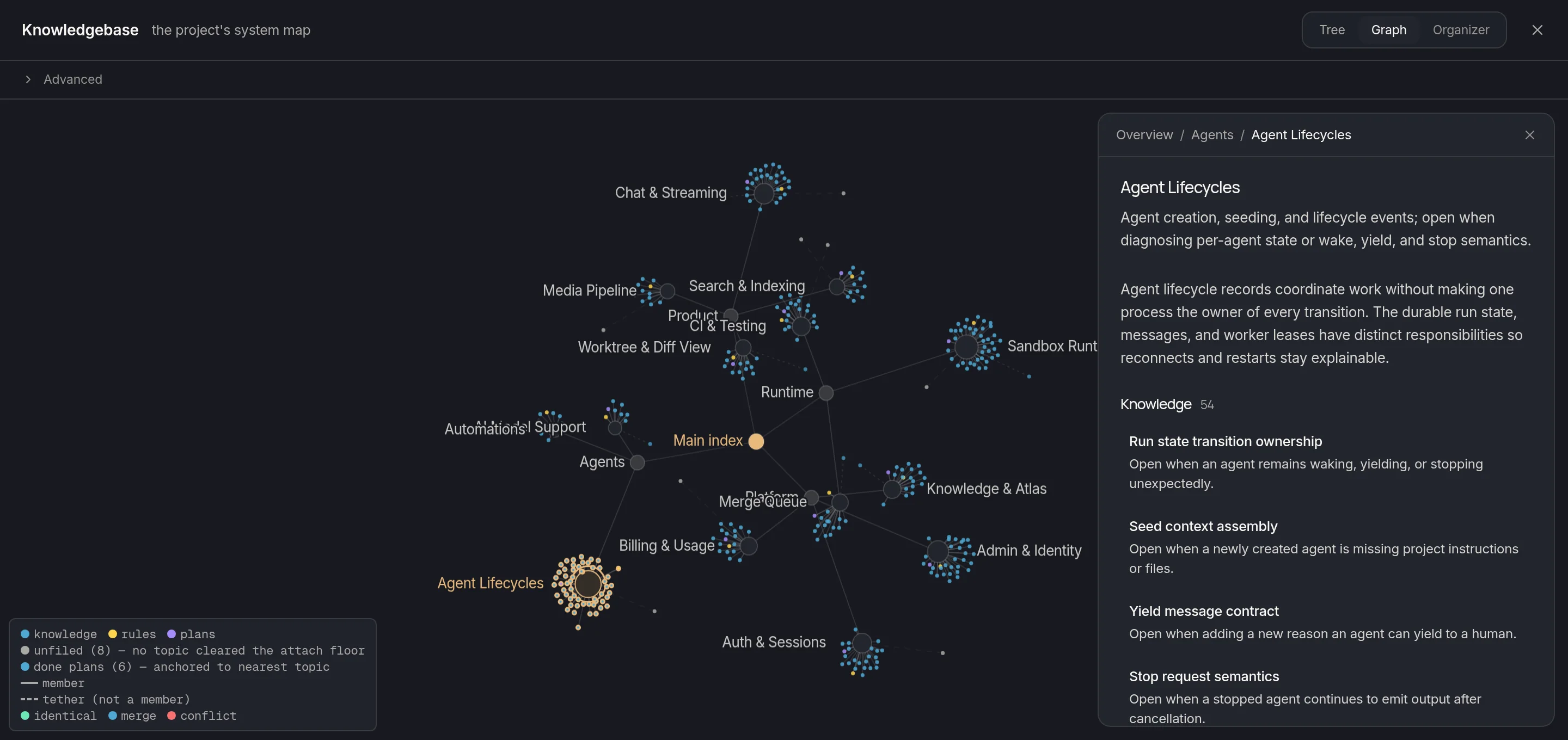
  • A shared knowledge base every agent reads, kept current automatically
Why darting.dev

Built for autonomous work, not autocomplete

Isolated sandboxes that never collide, proof on video, deep git, and a company brain — everything a swarm needs to take work from idea to merged.

Sandboxes that never collide

Every thread works in its own isolated cloud sandbox on its own branch, so one thread's edits can never break another's test run. Parallel work never trips over itself — no phantom failures, no wasted time or spend.

Fixes you can watch

Agents drive the real UI like a person — reproduce the bug, confirm the fix actually works, then send a video summary. Review the proof and merge in minutes, not hours.

Git-native, always in sync

PRs open and stay current automatically. When a teammate merges to main, every thread sees how far behind it is and updates in a click — so work never drifts out of date.

Your company brain

A background agent reads your codebase and writes a knowledge base — architecture, data model, conventions, the security model — that every agent is grounded in and your whole team shares. It stays current as the code changes.

Agents that do, not just code

Sandboxes aren't only for code. Standing automations run research, publish articles, answer support tickets, and more — on a schedule or a trigger.

Zero environment babysitting

No worktrees to juggle, no .env to copy, no remembering which server runs on which port. Every sandbox boots configured and ready.

Plugs into the tools you already use
ClaudeGrokGPT-5.6GitHubE2BPlaywrightPostgres
How it works

From prompt to pull request in four steps

  1. 01

    Create a project

    Paste a git URL, start from scratch, or connect a repo later. The sandbox clones and boots it for you — no worktrees, no .env copying, no ports to remember.

  2. 02

    Describe the outcome

    Chat with the lead agent. Simple asks get done directly; complex work becomes a living plan you review and Build when ready.

  3. 03

    The swarm works in isolation

    Threads fan out across separate sandboxes — building, running tests, and validating the UI like a human, none ever breaking another's run.

  4. 04

    Watch the proof, then merge

    Review video summaries and branch-aware diffs, then open a PR. Arm auto-merge when you're ready — green CI lands it without you babysitting.

Pricing

Start free. Scale when the swarm does.

A generous free tier to try it, usage-based plans as your agents take on more.

Ship your next feature with a swarm

Spin up your first project in under a minute. Bring a git repo or start from an empty one.