darting
Where teams ship together.
Team chat, cloud agents, and the entire shipping workflow in one place.
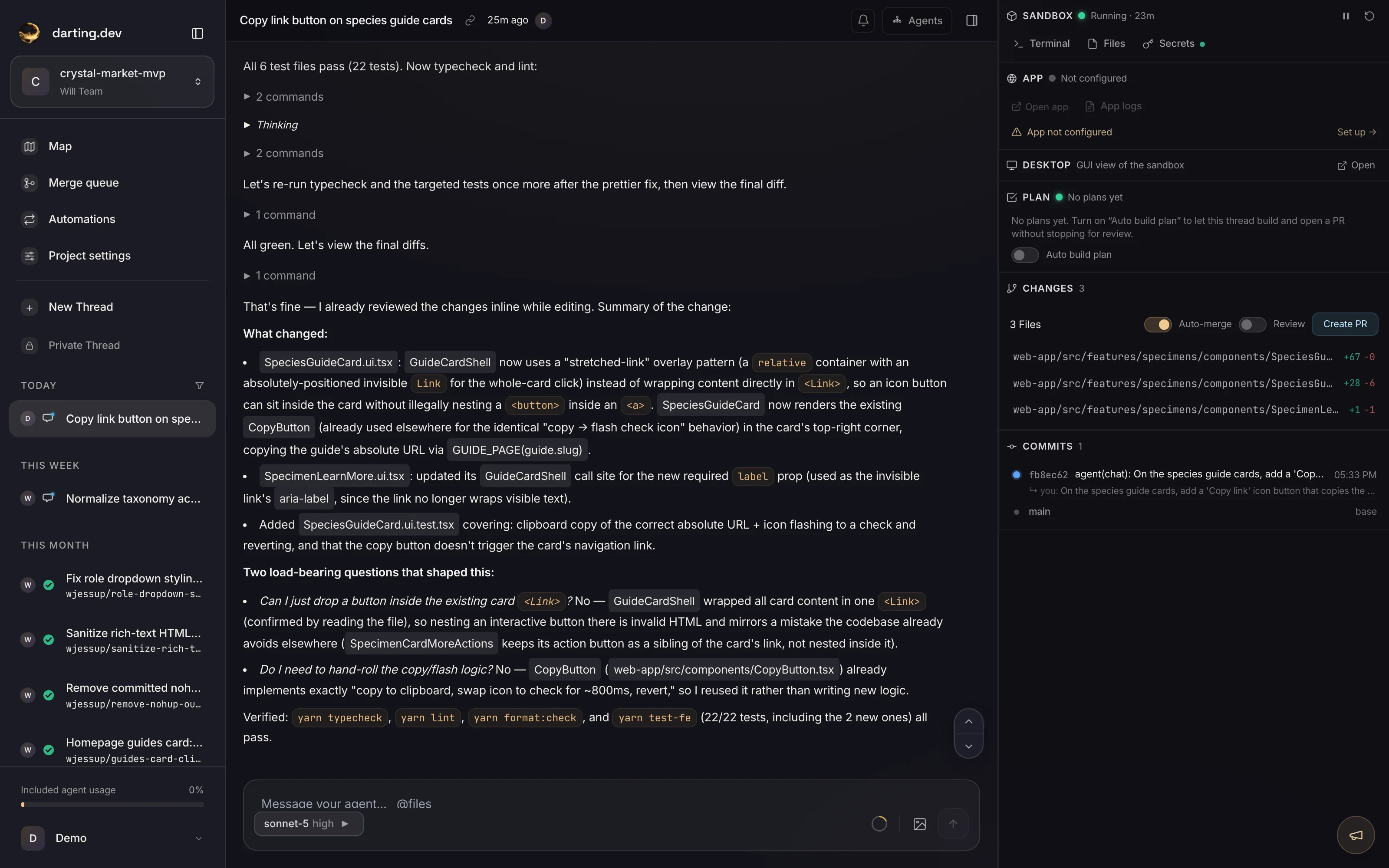
Editors type. Labs reason.Darting owns done —a running URL your team can see.
Ship serious code on the go.
Everything runs in the cloud, so your phone is a full seat at the table. Review the plan from the train, watch the proof video over coffee, and say “ship it” from wherever you are — the build, tests, and deploy never touch your machine.
No laptop, no terminal, no VPN. Just the conversation — and production at the other end of it.
The rest of the toolkit.
Cloud first
Web or phone. Close the lid — they keep going.
Always current
Latest code. Latest secrets. Conflicts resolved, not clobbered.
CI that keeps moving
Red checks get fixed. Deploys get tracked.
Memory that grows
A living knowledge base. Right answers, first time.
Nothing hidden
Prompts, transcripts, context. All yours.
Built for teams
People and agents, same thread. Review it. Ship it.
A plan, always current
Revised, tracked, approved. Nothing drifts.
Everyone gets a sandbox
Own branch. Own machine. No one trips over anyone.
Always in sync
PRs open themselves. One click to catch up.
Fixes you can watch
See the bug reproduced, the fix confirmed. Then merge.
More than code
Research, articles, support — on a schedule or a trigger.
A team, in parallel
A planner, a coder, a tester. All at once. No one waits.
What Darting is, in plain terms.
What is Darting?
Darting is a cloud platform for autonomous AI coding agents. You describe an outcome in chat; agents build it in isolated cloud sandboxes, verify it in a real browser, open and land the pull request, and deploy it to a live URL.
Is Darting an alternative to AI coding agents that run in an IDE or terminal?
Yes. Darting runs in the cloud rather than on your laptop: every thread gets its own sandbox, branch, PR lane, preview URL and desktop, agents keep working after you close the lid, and you can send prompts from the web or your phone.
Which AI models does Darting use?
Darting runs Claude, GPT, Grok and GLM side by side. Auto mode routes each step to the model that fits, and you can pin a model per thread or restrict models per project.
How is Darting priced?
Two ways to pay. The Auto Plan is $200/month and covers everything Darting decides on its own — Auto-routed turns, tier-spawned subagents, sandbox time, search and fetch — paced in 5-hour and weekly windows, stackable. Or pay as you go with prepaid credits at the provider's API rate; credits never expire. Named-model turns, video and image generation bill to credits either way. No seats, no per-user fees.
Does Darting verify that the code works?
Yes. A UI-driver agent drives your app in a real browser and records a video of the feature working. Agents also read and fix red CI checks and resolve merge conflicts against main before the PR lands.
Can Darting deploy the app?
Yes. Compatible static frontends with optional Workers-runtime backends deploy to https://<slug>.darting.app with automatic HTTPS, rebuilt from the default branch on every merge.
Can a team use Darting together?
Yes. Threads are shared: teammates read them, send turns into them and inherit their context, and talk to each other in team chat beside the agents. Teams get per-project model allow-lists, per-user quotas, admin usage reporting and one shared credit balance.
Is my code private?
Each thread runs in its own isolated cloud sandbox branched from your repo and torn down after use. Private repositories authenticate through the darting GitHub App or your own GitHub grant, scoped to that repository; API keys live in a vault agents can use but never read, and secrets never enter the chat transcript.
Describe the software. Get the live site.
Start with a conversation. Darting handles the build, proof, integration, and deployment — while keeping every detail there when you want it.